
CONTACT US
226-227, G.I.D.C Estate., Makarpura,Vadodara - 390010 Gujarat, India.
Phone: +91-97277 05851 , 2632084
Fax: +91-97277 05851
Marketing: +91-9099365060
After Sales/Services:+91-9727705852
Email: marketing.sumesh@gmail.com
+91-97277 05851

Home / Our Products/ Transformer/Insulating Oil Reclamation Plant
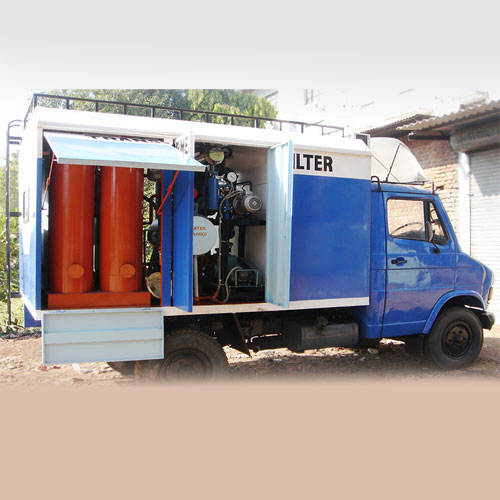
The reclamation of Transformer Oil is economically justifiable, cost effective and environmentally sounds. The reclamation is economically attractive because of increasing prices for both mineral and synthetic transformer coolants.
In our plant, oil is reclaimed by heating, filtration, free moisture removal by coalescer filters, activated fuller’s earth treatment and vacuum dehydration.
The plant will consist of mainly two things:
1. Fuller’s earth treatment plant with free moisture separation facility
2. Oil filtration and dehydration plant
The plant will be suitable for Oil treatment as described below:
Oil is taken into the raw oil storage tank with the help of vacuum. Then is allowed to settle in the tank and dirt, free water (if any) is drained out. Oil is sucked with the inlet pump. Then it is heated by passing through heater tank and then passed through spirafuge and coalescer filter to separate coarse contaminants and free moisture present in the oil.
After removal of free moisture oil is passed through the activated fuller's earth tank to remove acids and impurities such as breakdown products arising in the use of oil. Fuller's earth is used before vacuum treatment to provide cleaner feed and to give an oil final polish.
Then this oil is passed through the fine filter and vacuum degassing and dehydration chamber to remove the maximum moisture and other contaminants to achieve required oil quality / parameters.
1. Sludge Materials formed inside the transformer can be eliminated.
2. Wastage of Oil is minimum.
3. The system can also be used for periodical reconditioning.
4. Neither Transformer nor Oil is needed to be transported hence saving time (for shutdown).
5. Avoid major overhauling
6. Where overhauling of transformer is not possible
7. Simple and economical process.
8. System can be attached to a light vehicle.
A Transformer Oil Reclamation Plant is an oil treatment system designed to restore the usability of aged transformer insulating oil by removing acidic compounds, oxidation products, sludge, moisture and other contaminants. Unlike conventional oil filtration, the reclamation process uses activated Fuller's earth or another suitable adsorbent to remove certain chemical degradation products from used transformer oil.
Transformer oil reclamation can help reduce the need for complete oil replacement when the oil is suitable for treatment and meets the required specifications after processing.
The transformer oil reclamation process involves several treatment stages to improve the condition of used insulating oil:
Oil collection and settling: Used transformer oil is collected in a storage tank, where dirt and free water can settle before being drained.
Heating and separation: The oil is heated and passed through separation equipment and coalescer filters to remove coarse contaminants and free moisture.
Activated Fuller's earth treatment: The oil passes through an adsorbent treatment stage to remove certain acidic compounds and polar oxidation products.
Fine filtration: Fine filters remove remaining suspended particles.
Vacuum dehydration and degassing: Vacuum treatment helps remove moisture and dissolved gases, depending on the system design and operating conditions.
Oil quality testing: The treated oil is tested to verify whether it meets the required specifications for reuse.
The effectiveness of reclamation depends on the initial oil condition, treatment parameters, equipment configuration and post-treatment test results.
Transformer oil reclamation may be considered when oil analysis indicates ageing, increased acidity, sludge formation or chemical degradation. Over time, oxidation and operating conditions can affect the insulating properties and overall condition of transformer oil.
The appropriate treatment should be selected according to laboratory test results, transformer manufacturer recommendations and applicable oil quality requirements. When the main issues are moisture and suspended particles, filtration or dehydration may be sufficient. When chemical degradation products are present, reclamation may provide additional treatment.
Transformer oil filtration primarily removes moisture, suspended particles and other contaminants, depending on the equipment used. Transformer oil reclamation includes an additional adsorbent treatment stage designed to remove certain acidic compounds and polar oxidation products associated with oil ageing.
The choice between filtration, purification and reclamation depends on the condition of the oil and the results required. Oil testing helps determine the most appropriate treatment method and whether the oil can be reused safely.
An Insulating Oil Reclamation Plant can support transformer maintenance and used-oil treatment operations across several sectors, including:
Power generation plants and electrical substations
Electricity transmission and distribution utilities
Industrial manufacturing facilities
Transformer servicing and maintenance companies
Electrical infrastructure and power equipment service providers
On-site oil reclamation can help reduce oil transportation requirements and associated maintenance delays. A suitable plant configuration can also support periodic oil reconditioning as part of a planned transformer maintenance programme.
Before selecting a Transformer Oil Reclamation Plant, buyers should consider the following factors:
Oil condition: Review acidity, moisture, sludge, oxidation products and other relevant laboratory test results.
Processing capacity: Select a plant capacity suited to the volume of oil requiring treatment and the available maintenance window.
Treatment technology: Confirm the suitability of heating, coalescing, adsorbent treatment, fine filtration and vacuum dehydration stages.
Oil quality requirements: Establish the target parameters based on the intended application and applicable specifications.
Installation and mobility: Evaluate site conditions and whether a stationary or vehicle-mounted system is appropriate.
Maintenance and operating costs: Consider consumables, Fuller's earth replacement or handling, filter maintenance, energy consumption and servicing requirements.
Working with an experienced manufacturer can help determine the appropriate equipment configuration for the oil condition, application and operating requirements.