
CONTACT US
226-227, G.I.D.C Estate., Makarpura,Vadodara - 390010 Gujarat, India.
Phone: +91-97277 05851 , 2632084
Fax: +91-97277 05851
Marketing: +91-9099365060
After Sales/Services:+91-9727705852
Email: marketing.sumesh@gmail.com
+91-97277 05851

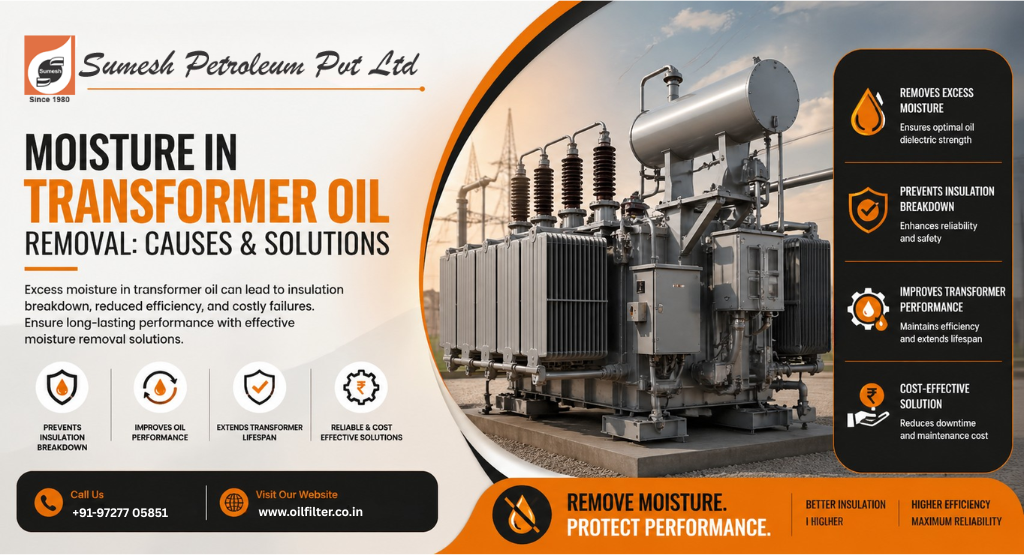
Transformer oil is the silent protector of your electrical equipment—until moisture sneaks in. Even a small amount of water contamination can reduce insulation strength, cause overheating, and lead to costly failures.
If you're wondering why this happens and how to fix it effectively, this guide breaks it down in simple terms—with practical solutions you can apply immediately.
Moisture contamination in transformer oil happens due to environmental exposure, aging, and operational issues.Moisture in transformer oil is mainly caused by air exposure, insulation aging, leaks, and temperature fluctuations. Water enters through breathing systems, खराब seals, or condensation. Over time, cellulose insulation releases moisture internally, increasing contamination levels and reducing dielectric strength.
Breathing of Transformer: Moist air enters through conservators during load changes
Aging Insulation: Paper insulation releases trapped moisture over time
Oil Oxidation: Chemical reactions generate water as a by
Seal Leakages: Damaged gaskets allow external moisture ingress
Poor Storage Practices: Exposure during handling or refilling
Moisture doesn’t just sit idle—it actively damages your transformer.
Moisture reduces dielectric strength, accelerates insulation degradation, and increases the risk of electrical breakdown. It also promotes sludge formation and reduces cooling efficiency, leading to overheating and possible transformer failure.
Reduced dielectric strength
Increased risk of internal faults
Faster aging of insulation
Formation of acids and sludge
Decreased equipment lifespan
Early detection saves major repair costs.
Moisture in transformer oil is detected using tests like Karl Fischer titration, breakdown voltage (BDV) test, and dissolved gas analysis (DGA). Low BDV values and high ppm moisture levels indicate contamination and the need for immediate treatment.
Karl Fischer Test – Accurate moisture measurement
BDV Test – Checks insulation strength
DGA – Identifies internal faults
Visual Inspection – Cloudy oil indicates contamination
A transformer oil drying system removes moisture, gases, and impurities through heat and vacuum technology.Moisture in transformer oil removal is done using vacuum dehydration systems that heat the oil and expose it to a vacuum. This process evaporates water and dissolved gases efficiently, restoring dielectric strength and improving oil quality without damaging the oil properties.
A vacuum dehydration plant is widely used for industrial-scale oil purification.
Oil is heated to release moisture
Vacuum chamber reduces boiling point
Water evaporates and is extracted
Clean, dry oil is recirculated
Removes free + dissolved water
Improves BDV instantly
Extends transformer life
Works on-site without shutdown (in many cases)
|
Feature |
Oil Filtration |
Vacuum Dehydration |
|---|---|---|
|
Removes Particles |
Yes |
Yes |
|
Removes Moisture |
Limited |
Highly Effective |
|
Removes Dissolved Gases |
No |
Yes |
|
Application |
Basic cleaning |
Complete oil restoration |
Insight: Filtration alone is not enough when moisture levels are high—dehydration is essential.
In one industrial project, a power plant faced repeated transformer tripping. Basic filtration didn’t solve the issue. After using a vacuum dehydration plant, moisture levels dropped significantly, BDV improved, and the transformer stabilized—saving replacement costs.
Improves insulation performance
Prevents unexpected breakdowns
Increases equipment reliability
Extends oil and transformer life
Reduces maintenance costs
At Sumesh Petroleum Pvt Ltd, we specialize in advanced oil purification and dehydration solutions designed for real industrial challenges.
Proven expertise in moisture in transformer oil removal
High-efficiency vacuum dehydration plants
Reliable after-sales support
Customized solutions for different industries
Focus on quality, performance, and long-term savings
Typically, moisture levels should be below 10–20 ppm depending on voltage class. Higher levels can reduce insulation strength and must be treated immediately.
No, standard filtration removes particles only. Moisture requires a vacuum dehydration plant for effective removal.
Oil testing should be done every 6–12 months or more frequently in critical applications.
It leads to insulation failure, overheating, and eventual transformer breakdown.
Yes, modern transformer oil drying systems allow on-site treatment without major downtime.
Moisture contamination can quietly damage your transformer—but the right solution can restore its performance quickly.
Get expert help from Sumesh Petroleum Pvt Ltd today.
👉 Contact us now for a customized solution or request a quote for a high-efficiency vacuum dehydration plant.

