
CONTACT US
226-227, G.I.D.C Estate., Makarpura,Vadodara - 390010 Gujarat, India.
Phone: +91-97277 05851 , 2632084
Fax: +91-97277 05851
Marketing: +91-9099365060
After Sales/Services:+91-9727705852
Email: marketing.sumesh@gmail.com
+91-97277 05851

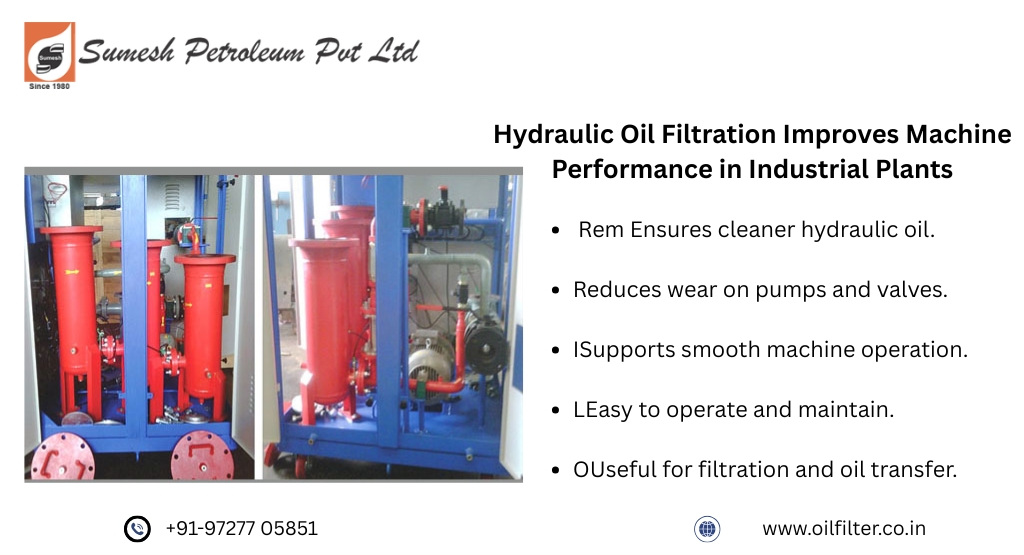
A hydraulic oil filtration system removes harmful contaminants such as solid particles, moisture and other impurities from hydraulic fluid. By maintaining cleaner oil, filtration can help protect hydraulic components, support consistent machine operation, reduce contamination-related wear and make preventive maintenance more effective in industrial plants.
Hydraulic systems depend on oil not only for power transmission but also for lubrication, cooling and protection of internal components.
When contaminants enter the fluid, they can circulate through pumps, valves, cylinders and other precision components. Depending on the contaminant and its concentration, this can contribute to wear, sticking valves, reduced component life and unreliable machine operation.
Common hydraulic-fluid contaminants include:
The important point is that clean-looking hydraulic oil is not necessarily clean enough for a hydraulic system. Fine particles may be too small to see but can still affect sensitive components.
A hydraulic oil filtration system circulates contaminated oil through one or more filter stages to capture unwanted particles and, depending on the equipment configuration, other contaminants.
A typical process is:
Contaminated hydraulic oil → suction → filtration → contaminant separation → clean oil → return to reservoir or equipment
The exact filtration arrangement depends on the application, oil condition, required cleanliness level and system design.
Some systems are installed directly into the hydraulic circuit, while offline hydraulic oil filtration systems operate separately from the main machine circuit. Offline treatment is also commonly known as kidney-loop filtration.
The main benefit is not simply "cleaner oil." The real objective is to create a cleaner operating environment for hydraulic components.
Abrasive particles can pass through hydraulic components and contribute to wear.
Removing these particles from the oil helps reduce the amount of abrasive contamination circulating through pumps, valves and actuators.
This is particularly important in systems containing precision hydraulic components with tight internal clearances.
Contamination can contribute to valve malfunction, restricted flow and inconsistent hydraulic operation.
Maintaining appropriate oil cleanliness can therefore support more stable equipment operation.
Filtration cannot eliminate every possible cause of hydraulic failure, but contamination control is an important part of hydraulic maintenance.
Hydraulic pumps and control valves can be sensitive to contaminated fluid.
A suitable filtration system helps control the particle load entering these components, potentially reducing contamination-related stress and wear.
The correct filtration level should be selected according to the hydraulic equipment manufacturer's requirements rather than choosing the finest filter available without considering flow and pressure-drop requirements.
It can help extend useful oil service life when contamination is a significant cause of oil degradation, but filtration does not restore every property of aged hydraulic oil.
Filtering suspended contaminants can reduce the circulating contaminant load. However, oil can also degrade through oxidation, thermal stress, additive depletion and chemical changes.
Therefore, an industrial oil cleaning system should not automatically be treated as an oil-regeneration system.
If hydraulic oil has significant chemical degradation, simply passing it through a particle filter may not restore its original condition.
The answer depends on the filtration technology.
| Contaminant | Mechanical Filtration | Specialized Treatment |
|---|---|---|
| Dirt and dust particles | ✓ | — |
| Metal particles | ✓ | — |
| Rust particles | ✓ | — |
| Fibres | ✓ | — |
| Sludge | ✓/Depends on filter | — |
| Free water | Limited | Water-separation equipment may be required |
| Dissolved water | Generally no | Vacuum dehydration may be required |
| Dissolved gases | No | Vacuum degassing may be required |
| Varnish | Depends on technology | Specialized varnish treatment may be required |
This distinction matters when choosing a hydraulic oil purifier machine. A buyer should first identify the contaminant rather than assuming every oil filtration machine removes every type of contamination.
These terms are often used interchangeably in marketing, but technically they can describe different treatment capabilities.
Hydraulic oil filtration generally focuses on removing particulate contamination.
Hydraulic oil purification can refer to a broader treatment process that may include particle removal, water separation or other conditioning processes depending on the equipment.
For example, if an industrial hydraulic system has mainly metal particles and dust, a suitable filtration system may be enough.
If the oil also contains substantial moisture, the treatment system may require an additional water-removal process.
Both approaches have useful applications.
| Feature | In-Line Filtration | Offline Filtration |
|---|---|---|
| Installation | Integrated into hydraulic circuit | Separate filtration loop |
| Continuous protection | Yes | Depends on operating schedule |
| Maintenance filtration | Possible | Very suitable |
| Hydraulic circuit modification | Usually required | Usually less intrusive |
| Suitable for existing systems | Depends on design | Often practical |
| Filtration during machine operation | Possible | Depends on setup |
An offline system can be valuable when an existing hydraulic machine needs additional oil-cleaning capacity without substantially modifying its primary hydraulic circuit.
It can continuously circulate reservoir oil through a separate filtration loop, allowing contamination to be controlled independently of the machine's main hydraulic flow.
A hydraulic oil filtration system can be relevant wherever hydraulic equipment depends on clean, properly maintained fluid.
Injection molding equipment uses hydraulic systems for functions such as clamping and injection in hydraulic machine designs. Contamination control can help protect pumps, valves and other hydraulic components.
Steel plants operate heavy machinery in demanding environments where dust, metal particles and other contaminants can enter hydraulic systems.
Oil filtration can form part of a broader contamination-control and preventive-maintenance program.
Excavators, loaders, cranes and other hydraulic equipment operate in environments where dirt and dust exposure can be significant.
Proper hydraulic oil filtration helps control particulate contamination within the hydraulic circuit.
Presses, forming equipment, machine tools and other industrial machines may rely on hydraulic power systems that require controlled fluid cleanliness.
Mining environments can expose hydraulic systems to substantial dust and particulate contamination. Filtration becomes an important part of maintaining hydraulic-fluid cleanliness.
Hydraulic systems used for industrial controls and auxiliary equipment can also benefit from appropriate fluid contamination management.
Filtration requirements should ideally be determined through oil analysis and contamination monitoring, but certain operational symptoms can indicate that investigation is needed.
Look for:
These symptoms do not automatically prove that contaminated oil is the cause. They should trigger inspection and testing rather than immediate assumptions.
Choosing equipment should begin with the hydraulic system—not the machine's advertised filtration capacity.
Determine whether the primary problem is:
Different problems require different treatment methods.
Hydraulic equipment manufacturers may specify a required fluid cleanliness level.
The filtration system should be selected to help achieve the required cleanliness target without creating unacceptable pressure drop or flow restrictions.
The required flow rate depends on the reservoir size, contamination level, operating conditions and maintenance objective.
A larger flow rate is not automatically better if the filtration process is poorly matched to the hydraulic system.
Look beyond the advertised micron rating.
Important considerations include:
A portable hydraulic oil filtration system can be useful for servicing multiple machines from one unit.
A permanently installed system may be preferable where a particular hydraulic system requires continuous or scheduled offline filtration.
An industrial oil cleaning system is equipment designed to remove contaminants from lubricating or hydraulic oil so that the fluid can be returned to service when its condition permits.
The system can be configured around the type of oil and contaminant involved.
For hydraulic applications, the priority is usually maintaining suitable particle cleanliness and controlling other contaminants that can affect hydraulic components.
The term "oil cleaning" should therefore be evaluated carefully when comparing equipment. Ask exactly which contaminants the system is designed to remove and how the treatment is performed.
A lower micron number does not automatically make a filtration system better. Filter efficiency, flow, pressure drop and dirt-holding capacity all matter.
Standard mechanical filtration is primarily intended for particulate removal. If water is the main problem, dedicated water-separation or vacuum dehydration technology may be required.
The hydraulic system's specified cleanliness level and component requirements should influence filter selection.
Different machines may have different flow rates, pressure conditions, oil types and cleanliness requirements.
Reactive filtration after a hydraulic component fails can be more disruptive than incorporating oil cleanliness monitoring and filtration into preventive maintenance.
Oil analysis provides a more reliable basis for deciding what treatment is necessary.
Depending on the hydraulic application, testing may evaluate:
The results can help distinguish between contamination that filtration can address and oil degradation that requires another maintenance approach.
This is one of the most useful ways to avoid buying a filtration system that does not address the actual problem.
For industrial buyers in India, selecting an oil filtration solution should involve more than comparing machine capacity or filter ratings.
Sumesh Petroleum Pvt Ltd can position its hydraulic oil filtration solutions around the specific operating requirement: the type of hydraulic oil, contamination involved, desired cleanliness level, filtration method and application environment.
For plants in manufacturing, steel, injection molding, construction equipment and other hydraulic-intensive sectors, the right approach is to first understand the oil condition and machine requirements, then select an appropriate filtration configuration.
A hydraulic oil filtration system removes contaminants from hydraulic fluid, primarily suspended particles. Depending on its configuration, additional treatment may be available for water or other contaminants.
By controlling contamination in the hydraulic fluid, filtration can help reduce contamination-related wear, support cleaner hydraulic operation and protect sensitive components.
Not necessarily. Standard mechanical filtration primarily removes solid particles. Water removal requires equipment specifically designed for free or dissolved moisture.
It is a separate filtration circuit that circulates hydraulic oil from the reservoir through a filtration unit and returns the cleaned oil to the system. It is also commonly called kidney-loop filtration.
A hydraulic oil purifier machine is generally used to condition contaminated hydraulic oil. However, the exact capabilities vary by equipment design, so buyers should verify whether the machine handles particles, water, sludge or other contaminants.
There is no universal filtration interval. The appropriate schedule depends on oil-analysis results, contamination levels, machine operating conditions, filter condition and the hydraulic equipment manufacturer's maintenance recommendations.
It can be. A portable unit can be moved between compatible hydraulic systems, provided its flow, pressure, filtration configuration and connection requirements are suitable for each application.
No. Clean oil can reduce contamination-related risks, but machine life also depends on correct lubrication, operating conditions, maintenance, component quality, temperature control and other factors.
A hydraulic oil filtration system is most effective when it is treated as part of a broader contamination-control strategy rather than as a standalone cure for every hydraulic problem. The right system should match the contaminant, required cleanliness level, hydraulic circuit and maintenance objective.
For industrial plants, the practical sequence is simple:
Test the oil → identify the contamination → define the cleanliness requirement → select the appropriate filtration technology → verify the result.
That approach helps ensure the filtration equipment solves the actual hydraulic oil problem, rather than simply adding another machine to the maintenance process.
Read more:-How to Extend Transformer Life Using Online Oil Filtration Systems

